From alerts to action: Where reliability is actually won
Observability has evolved dramatically in the past decade.
The industry has moved from basic uptime checks to full-stack observability (FSO), including metrics, logs, traces, and real user monitoring. Observability tools like ManageEngine FSO can detect anomalies in little time.
And yet, outages still last longer than they should.
Observability has matured. Response hasn’t .
Most IT teams today have the tools to know when something breaks. But knowing is not the same as resolving.
In many organizations, the incident life cycle still looks like this:
An alert is triggered.
Multiple people get notified.
No one is sure who owns the ticket.
Context is scattered across tools.
Escalation happens late.
Resolution takes longer than expected.
The hidden cost of poor incident response
When incident response is unstructured, the impact compounds quickly:
Longer mean time to resolution (MTTR) due to delayed ownership.
Alert fatigue as engineers get overwhelmed.
Operational friction from manual coordination.
Inconsistent handling across similar incidents.
Over time, this erodes both reliability and team efficiency.
From alerting to incident management
High-performing teams approach this differently. They treat alerts as inputs into a structured incident response system, not as the system itself.
This includes:
Defined ownership through on-call schedules.
Automated alert routing based on context.
Escalation policies to prevent delays.
Centralized incident tracking.
Integration with monitoring tools for real-time context.
The goal is simple: Reduce the time between detection and meaningful action.
Bridging the gap with integrated workflows
This is where integrations between observability and incident management platforms become critical.
For example, combining ManageEngine FSO with ilert allows teams to:
Automatically convert alerts into incidents.
Route them to the right on-call engineer.
Escalate if no action is taken.
Maintain a clear incident timeline.
Coordinate response without switching tools.
Instead of relying on manual intervention, the system enforces structure.
Why this matters now
Modern systems are highly complex, operating across a mix of cloud and on-premises environments while relying heavily on multiple interconnected services and APIs. At the same time, they are expected to maintain near-zero downtime, making reliability, coordination, and real-time visibility more critical than ever.
In this environment, delays in response are often more damaging than failures themselves. Reliability is no longer defined by whether issues occur but by how quickly and effectively teams respond.
Turning insight into action
Recognizing the problem is one thing. Fixing it requires a clear approach.
If your team is still relying on alerts alone, it’s worth rethinking how incidents are handled, from detection to resolution.
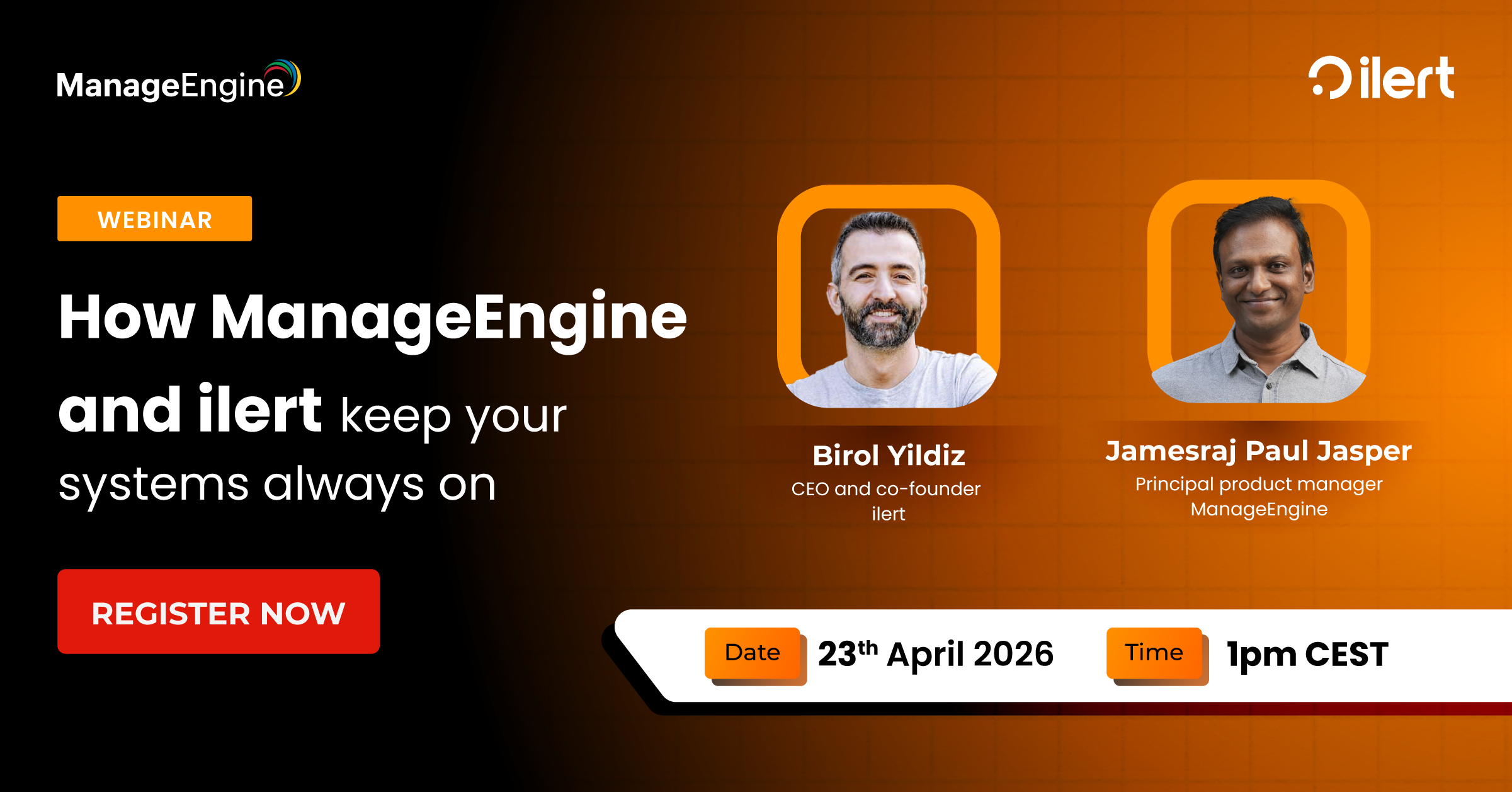
Join our upcoming webinar to see how ManageEngine FSO and ilert work together to turn alerts into structured, automated incident response workflows.
In this session, you’ll learn how to:
Route alerts intelligently to the right responders.
Automate escalation and on-call management.
Reduce alert fatigue without losing visibility.
Improve MTTR with integrated monitoring and response.
Date and time: Apr. 23, 2026 | 1pm CEST
Speakers:
Birol Yildiz, CEO and co-founder, ilert
Jamesraj Paul Jasper, Principal product manager, ManageEngine FSO
Register now and build a more resilient incident response system.